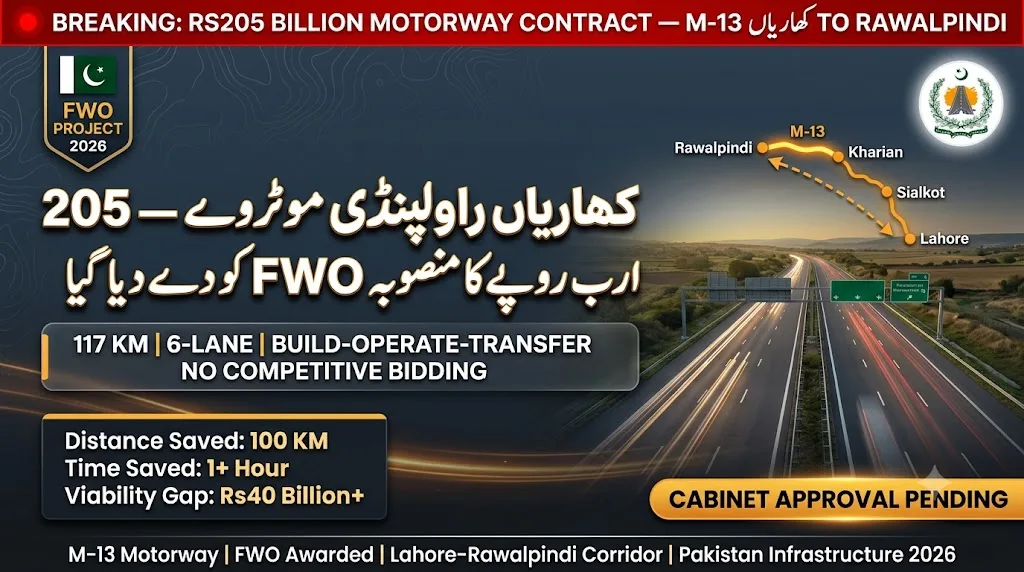
FWO Kharian Rawalpindi Motorway: Rs205 Billion M-13 Project Awarded Without Competitive Bidding
One of Pakistan’s most significant infrastructure decisions of 2026 is now drawing both attention and scrutiny. The government has moved to hand the FWO Kharian Rawalpindi Motorway contract to the Frontier Works Organisation through a negotiated procurement process, bypassing the competitive international bidding that regulators had previously directed. The project, officially designated M-13, stretches 117 kilometres and carries an estimated price tag of Rs205 billion. Here’s a clear breakdown of what’s happening, why it matters, and what questions remain unanswered.
What Is the Kharian Rawalpindi Motorway M-13?
The Kharian Rawalpindi Motorway is a major highway project forming part of the broader Lahore to Rawalpindi motorway corridor. It covers 117 kilometres and is being built as a six-lane motorway on a build-operate-transfer basis, meaning the contractor builds it, operates it for a defined period, and then transfers ownership back to the government.
The corridor is expected to reduce the Lahore to Rawalpindi travel distance by roughly 100 kilometres compared to using the existing Lahore to Islamabad motorway route. That’s a meaningful reduction in commute time, likely cutting well over an hour off the journey. For freight, passenger transport, and regional business connectivity, those savings add up considerably over time.
The project was approved by the Executive Committee of the National Economic Council in early April 2026 at Rs203.32 billion. Since then the figure has been revised upward to Rs205 billion, a relatively modest adjustment at that scale.
Why Was FWO Selected Without Competitive Bidding?
The decision to award the FWO Kharian Rawalpindi Motorway contract through negotiated procurement rather than open international bidding has raised eyebrows, not least because Ecnec itself had directed that international competitive bidding be used when it originally considered the project.
The National Highway Authority argued before the Public Private Partnership Authority board that FWO was uniquely positioned for fast execution. The reasoning rested on continuity. FWO had already completed two adjoining sections of the Lahore to Rawalpindi motorway corridor, specifically the Lahore to Sialkot and Sialkot to Kharian segments. Having the same organization handle the next stretch, the Kharian to Rawalpindi section, would allow immediate mobilization without the delays that a fresh procurement process inevitably introduces.
NHA’s position was that the project was required on a fast-track basis. Launching a new international bidding round, qualifying bidders, evaluating proposals, and finalizing contracts could consume a year or more. Given that the corridor has been years in the making already, that argument carries some practical weight.
The P3A board’s approval for negotiated contracting with FWO invoked Section 20 of the P3A Act, which does allow negotiated procurement under specific circumstances. That legal provision gives the process a formal basis, even if the optics of bypassing competitive bidding on a two-hundred-billion-rupee project remain difficult to ignore.
Project Background and Cost History
The cost story of the Kharian Rawalpindi Motorway project is one of the more striking elements of the whole affair. The table below captures how the project’s financial profile has evolved.
| Milestone | Estimated Cost | Notes |
|---|---|---|
| Ecnec Approval, January 2022 | Rs96 billion | Original four-lane design |
| Project Upgraded | Significant cost increase | Upgrade to six-lane ordered by SIFC |
| Ecnec Re-approval, April 2026 | Rs203.32 billion | Revised six-lane design estimate |
| Current Estimate | Rs205 billion | Final figure under review by P3A board |
The cost has more than doubled since the project was first approved four years ago. The primary driver of that increase was the Special Investment Facilitation Council’s decision to upgrade the motorway from four lanes to six lanes. That is a substantial change in scope and explains much of the cost escalation. Still, a project more than doubling in price between approval stages is the kind of trajectory that invites questions about original cost estimation discipline.
The project also carries a financing viability gap exceeding Rs40 billion. That shortfall will be covered by the federal government, meaning Pakistani taxpayers are effectively subsidizing the economics that make this BOT project viable for the operator.
Who Is the Frontier Works Organisation?
The Frontier Works Organisation is the engineering and construction arm of the Pakistan Army. It has a long track record of executing major infrastructure projects across Pakistan, including roads, tunnels, and strategic connectivity corridors in difficult terrain. FWO’s involvement in the earlier Lahore to Sialkot and Sialkot to Kharian motorway sections is precisely what the NHA cited when making the case for continuity.
FWO projects often move faster than civilian contractor timelines. Military discipline, internal procurement chains, and reduced exposure to some of the coordination problems that affect civilian construction companies give FWO genuine execution advantages on large-scale linear infrastructure. These are real factors, not just justifications constructed after the fact.
At the same time, awarding major public contracts without competitive bidding removes price discovery from the process. Without competing bids, there’s no independent market signal about whether Rs205 billion represents a fair price for this particular scope of work. That’s a legitimate concern regardless of the contractor’s capabilities.
What This Project Means for Regional Connectivity
Beyond the procurement controversy, the M-13 Motorway represents genuine infrastructure value for Pakistan’s most economically active corridor. The Lahore to Rawalpindi route carries enormous volumes of passenger and freight traffic. An alternative corridor that cuts distance and travel time improves logistics costs, eases congestion on existing routes, and strengthens the economic links between Punjab’s two largest urban agglomerations and the capital.
The build-operate-transfer structure also means the project doesn’t require the government to fund construction directly upfront, at least beyond the viability gap payment. Over the BOT period, toll revenue from motorway users will flow to the operator, eventually transitioning to public ownership.
Frequently Asked Questions
Q: What is the FWO Kharian Rawalpindi Motorway and what is it designed for?
It’s a 117-kilometre, six-lane motorway forming the M-13 designation within the Lahore to Rawalpindi corridor. The project aims to cut the travel distance between Lahore and Rawalpindi by about 100 kilometres and reduce journey time by more than an hour compared to the existing motorway route. It’s being built on a build-operate-transfer basis, which means toll-funded recovery over a defined operating period before the asset transfers to government ownership.
Q: Why did the government bypass competitive bidding for this motorway contract?
The National Highway Authority argued that FWO had already built the two preceding sections of the same corridor, making continuity and fast mobilization possible without running a fresh procurement process. The P3A board accepted that reasoning and used Section 20 of the P3A Act, which allows negotiated procurement in certain circumstances, as the legal basis for the decision. The matter still needs federal cabinet endorsement.
Q: How did the project cost go from Rs96 billion to Rs205 billion?
The original Rs96 billion estimate from January 2022 was based on a four-lane motorway design. The Special Investment Facilitation Council later directed that the project be upgraded to six lanes. Expanding lane capacity significantly increases earthworks, pavement, bridge, and interchange costs across 117 kilometres. That scope change, combined with inflation over four years, more than doubled the project’s cost.
Q: What is the Rs40 billion viability gap funding?
The viability gap is the difference between what toll revenues are projected to generate over the BOT period and what’s needed to make the project financially viable for the private operator. When projected toll revenues alone aren’t enough to cover construction and operating costs at a reasonable return, governments provide a upfront grant to bridge that gap. Here, the federal government will provide more than Rs40 billion to make the project work on a BOT structure.
Q: When is the Kharian Rawalpindi Motorway expected to be completed?
No official construction timeline or completion date has been publicly announced as of the latest available information. The government has emphasized a fast-track approach as the rationale for bypassing competitive bidding, but concrete milestones and an opening date have not yet been shared publicly. Federal cabinet approval of the contract arrangement is still pending.
Q: Has Ecnec approved the current version of this project?
Yes. Ecnec re-approved the project in early April 2026 at an updated cost of Rs203.32 billion based on the six-lane design. At that time, Ecnec also directed that procurement proceed through international competitive bidding. The current P3A board decision to recommend negotiated contracting with FWO effectively reverses that procurement direction, which is why the matter now needs to return to the federal cabinet for formal sign-off.